

 English
 中文简体
中文简体 русский
 Deutsch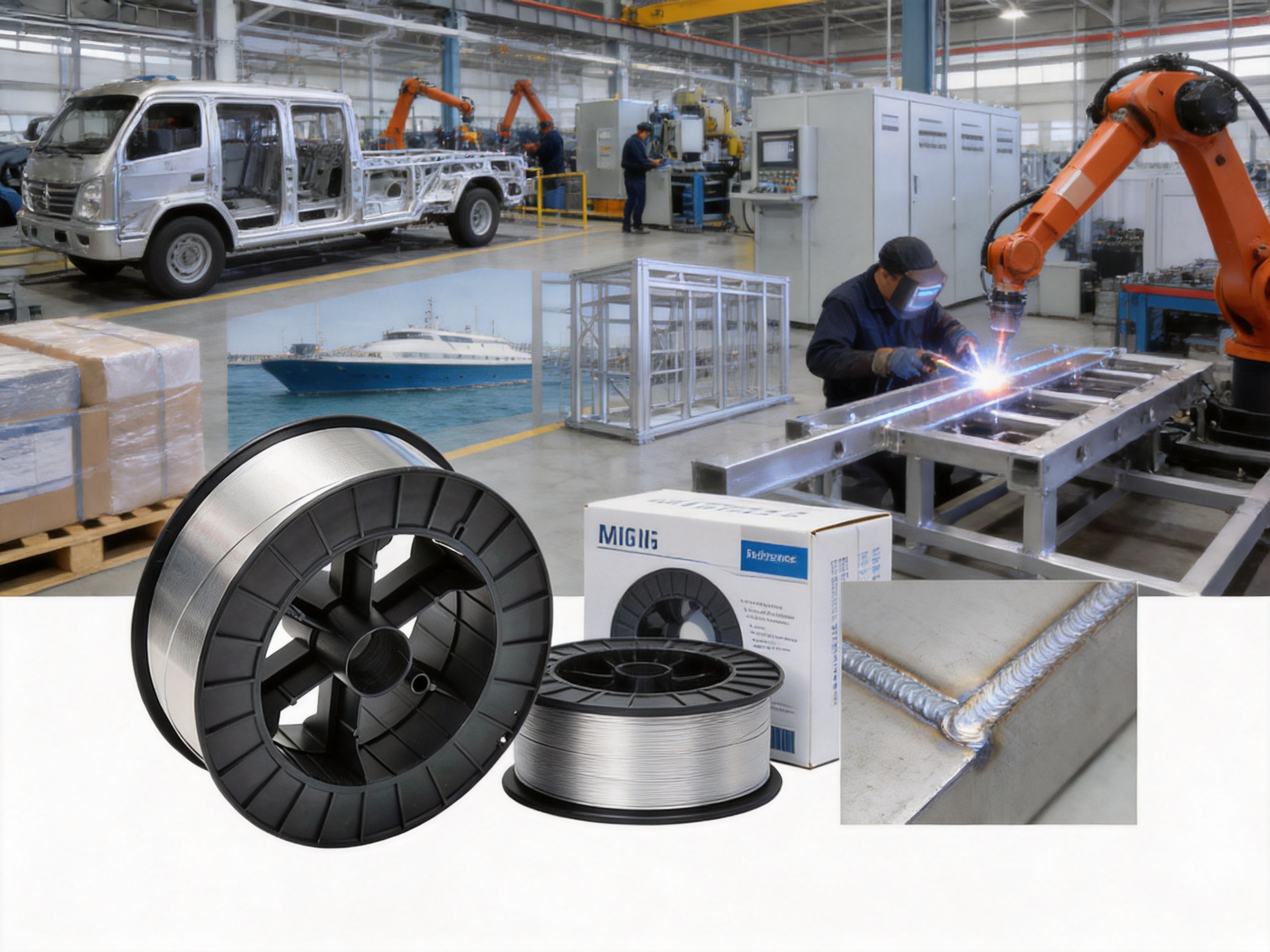
MIG wire is a critical consumable in modern aluminum and aluminum alloy welding. Used primarily as a melting electrode in argon-shielded arc welding, it provides the filler metal required to join aluminum components while supporting stable arc operation, controlled metal transfer, and efficient deposition. In applications where productivity, appearance, weight reduction, corrosion resistance, and structural reliability are important, the quality of the welding wire directly influences the quality of the finished assembly.
Aluminum welding presents challenges that are different from those associated with carbon steel or stainless steel. Aluminum has high thermal conductivity, a relatively low melting temperature, and a naturally occurring oxide layer with a melting point considerably higher than that of the base metal. These characteristics make wire composition, surface condition, dimensional consistency, and packaging especially important. A properly manufactured MIG wire helps the welding system feed the filler metal smoothly, maintain a stable arc, and create a sound weld when the correct welding parameters and shielding conditions are used.
Jiangsu Hetuo Aluminum Wire Co., Ltd. supplies aluminum wire, aluminum alloy wire, and aluminum and aluminum alloy welding materials for industrial customers. Established in 2019, the company has developed a manufacturing system focused on high-purity aluminum wire, high-strength aluminum alloy wire, and welding materials. Its 40,000-square-meter factory, professional technical team, advanced production equipment, and quality management systems support the manufacture of aluminum-based products for demanding domestic and overseas markets.
This article examines the function, advantages, manufacturing process, quality factors, applications, and selection considerations associated with MIG wire. It also explains how a specialized aluminum wire manufacturer can create value for distributors, welding service providers, fabricators, and end users.
Content
- 1 Understanding MIG Wire for Aluminum Welding
- 2 Why Aluminum MIG Wire Requires Specialized Manufacturing
- 3 Core Advantages of High-Quality MIG Wire
- 4 Product and Material Considerations
- 5 Manufacturing Strengths Supporting MIG Wire Quality
- 6 Advantages over General-Purpose and Poorly Controlled Alternatives
- 7 Recommended Welding and Handling Practices
- 8 Industrial Applications
- 9 Quality Factors for Purchasing Decisions
- 10 Product Selection Guide
- 11 Why Supplier Capability Matters
- 12 Environmental and Sustainability Considerations
- 13 Common Causes of MIG Welding Problems
- 14 Application Support and Customer Cooperation
- 15 Frequently Asked Questions
- 15.1 What is MIG wire?
- 15.2 What is the primary use of aluminum MIG wire?
- 15.3 Can one wire grade be used for every aluminum alloy?
- 15.4 Why is surface cleanliness important?
- 15.5 Why does wire diameter matter?
- 15.6 What makes aluminum wire difficult to feed?
- 15.7 How should MIG wire be stored?
- 15.8 Does high-quality wire eliminate welding defects?
- 15.9 What quality systems support the company’s manufacturing?
- 15.10 What products does the company manufacture?
- 15.11 Can the wire be used in automated welding?
- 15.12 What information should be provided when requesting a quotation?
- 16 Conclusion
- 17 References
- 18 Product: MIG Wire
Understanding MIG Wire for Aluminum Welding
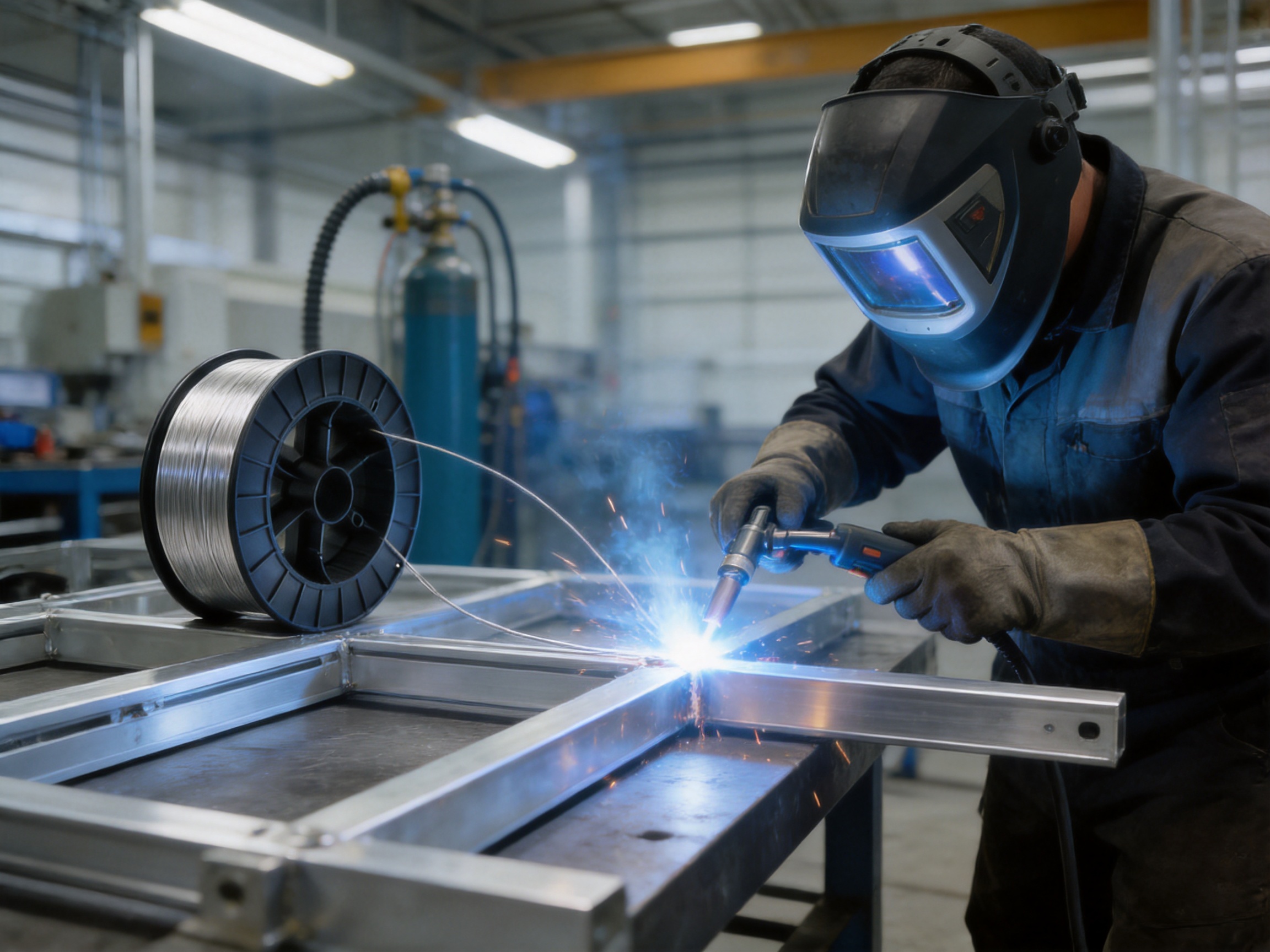
MIG stands for Metal Inert Gas welding. The process is also commonly referred to as gas metal arc welding, or GMAW, when the technical process name is used. During welding, a continuous wire electrode is fed through a welding torch. An electric arc forms between the wire and the workpiece, melting both the electrode and part of the base metal. The molten filler metal transfers into the weld pool, while an inert shielding gas protects the arc and molten metal from atmospheric contamination.
For aluminum welding, argon is widely used as the shielding gas, although specific applications may use gas mixtures or specialized procedures. The selected wire must be compatible with the base aluminum alloy, the required mechanical properties, the service environment, and the welding equipment. The correct relationship between wire chemistry, wire diameter, welding current, voltage, travel speed, shielding gas, and joint design determines the final weld result.
Unlike manual stick electrodes, MIG wire is supplied as a continuous consumable. This continuous format enables long welds, automated welding, robotic welding, and high-volume fabrication. It also reduces the need to stop frequently to replace electrodes. In production environments, this can improve productivity and make weld quality more repeatable.
The phrase “melting electrode argon arc welding” describes the essential role of the wire. The wire is not simply a delivery medium; it becomes part of the welded joint. Its alloy composition and physical condition therefore affect the weld’s strength, ductility, corrosion behavior, appearance, and resistance to defects.
Why Aluminum MIG Wire Requires Specialized Manufacturing
Aluminum is lightweight and highly conductive, but these benefits also create technical difficulties during welding. The material rapidly conducts heat away from the welding zone. As a result, the welding system may require relatively high current and carefully controlled heat input to establish adequate fusion. At the same time, excessive heat can cause burn-through, distortion, or loss of dimensional accuracy in thin sections.
The oxide film on aluminum is another important factor. This film is chemically stable and has a much higher melting temperature than the aluminum beneath it. If surface preparation, arc settings, or shielding conditions are inadequate, the oxide may contribute to inclusions, lack of fusion, or unstable arc behavior. The welding wire cannot solve every process problem, but a clean, consistent wire with suitable alloy chemistry helps establish a more reliable welding operation.
Aluminum wire is softer than many steel welding wires. This softness makes it more sensitive to feeding resistance, liner condition, contact-tip fit, spool alignment, and feeding-system design. Wire with inconsistent diameter, surface contamination, excessive ovality, or poor winding can increase feeding problems. A specialized manufacturer must therefore control not only the chemical composition but also the wire’s geometry, surface finish, winding quality, and packaging integrity.
High-quality MIG wire should be produced using controlled raw materials and a process capable of maintaining consistent dimensions. The manufacturing route may include alloy preparation, casting or rod production, heat treatment where applicable, drawing, surface treatment, inspection, winding, and packaging. Each step can influence the final performance of the welding consumable.
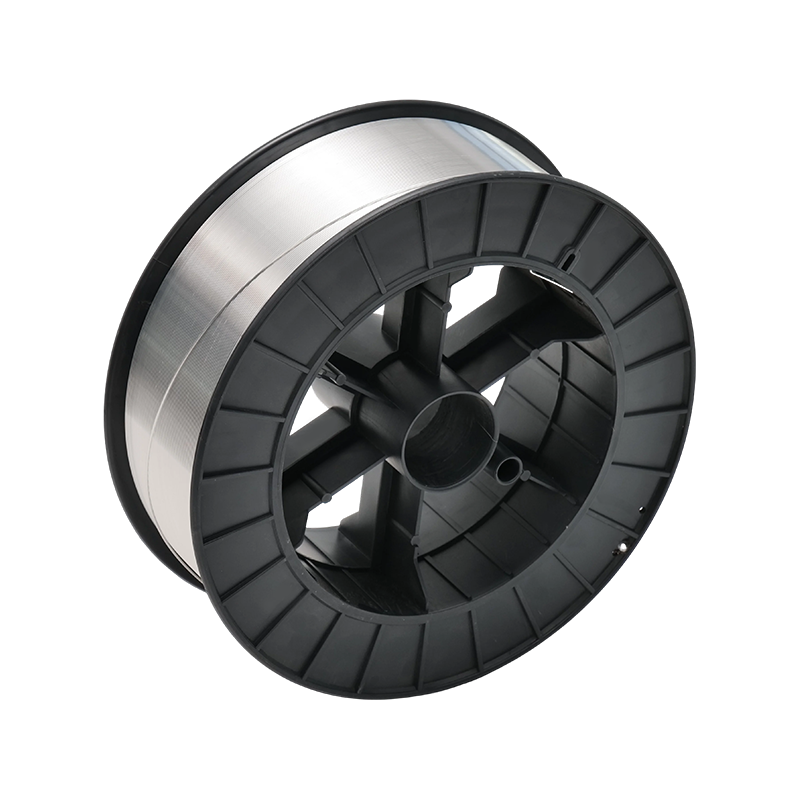
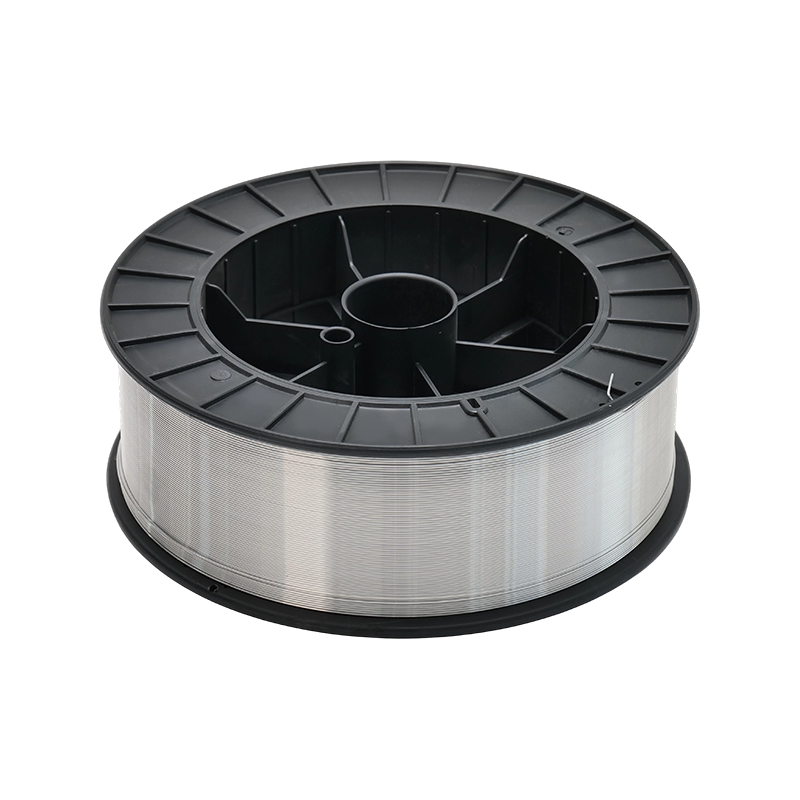
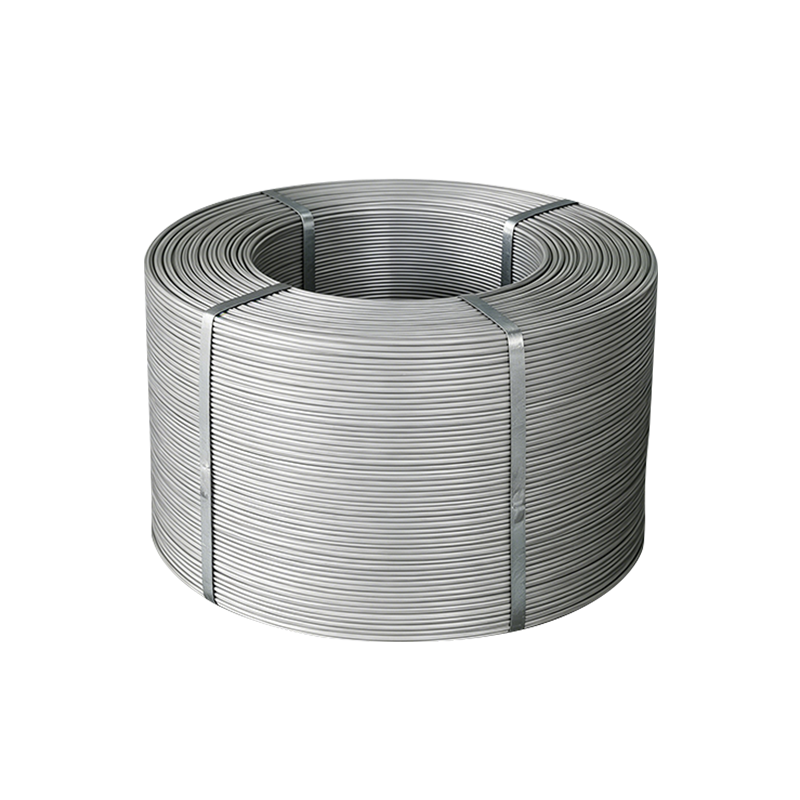
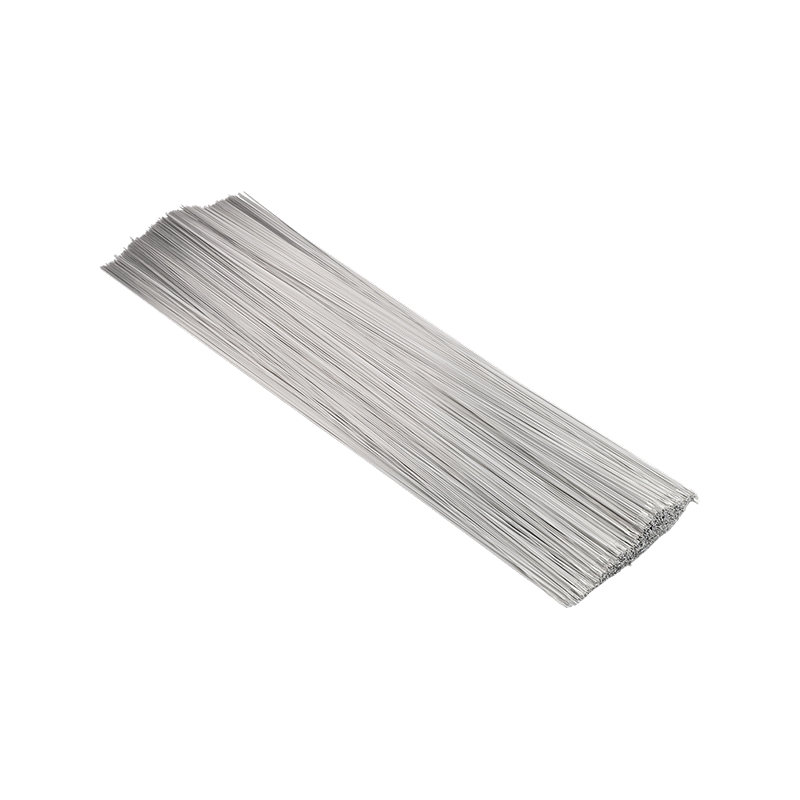
MIG Wire
Core Advantages of High-Quality MIG Wire
Stable Feeding Performance
Continuous wire feeding is essential to MIG welding. The wire must travel from the spool through the drive rolls, liner, contact tip, and torch without excessive friction or deformation. Consistent diameter and suitable surface characteristics help reduce feeding resistance and minimize interruptions.
Stable feeding supports a more uniform arc length and metal transfer rate. It can also reduce the frequency of bird-nesting, wire slipping, contact-tip blockage, and unplanned stops. These benefits are especially important for automated and semi-automated operations, where a small feeding problem can interrupt an entire production sequence.
Consistent Arc Behavior
The quality and consistency of the wire influence the relationship between the electrode and the arc. A uniform wire helps maintain predictable current transfer and supports stable droplet formation. When the wire is manufactured with controlled chemistry and dimensions, welders can more easily establish repeatable operating parameters.
Stable arc behavior contributes to smoother metal transfer, fewer spatter-related problems, and more consistent bead formation. It also simplifies parameter development when a customer changes from one production batch to another or expands production to additional welding stations.
Improved Weld Appearance
Aluminum components are often visible in the final product, so weld appearance may be an important commercial and technical consideration. A suitable MIG wire, combined with proper surface preparation and welding parameters, can help produce a uniform bead profile and controlled wetting at the joint edges.
Weld appearance is not merely cosmetic. A consistent bead may indicate that the welding process is operating within an appropriate range. In contrast, irregular bead shape, excessive spatter, porosity, or undercut may indicate contamination, incorrect gas flow, unsuitable heat input, or wire-related inconsistency.
Efficient Deposition
Because MIG welding uses a continuous wire electrode, it can deposit filler metal at a high rate compared with many manual welding methods. This makes it appropriate for fabrication lines, structural assemblies, transportation components, machinery, containers, and other products that require repeated welds.
Efficient deposition can reduce labor time and improve equipment utilization. When the wire feeds smoothly and the spool is wound correctly, the operator can spend more time welding and less time correcting feeding problems or replacing damaged consumable packaging.
Compatibility with Automated Welding
Modern factories increasingly use robotic welding, automatic seam welding, and digitally controlled welding power sources. These systems depend on stable consumables. Variations in wire diameter, surface condition, or winding tension can affect the robot’s programmed parameters and may lead to inconsistent results.
Reliable MIG wire supports the repeatability required by automated equipment. It can help manufacturers maintain consistent travel speed, wire feed speed, current, voltage, and deposition rate across multiple production cycles. This is valuable for industries in which traceability, repeatability, and productivity are closely connected.
Support for Lightweight Product Design
Aluminum is widely used to reduce product weight while retaining useful strength and corrosion resistance. Welding wire enables manufacturers to join aluminum components without introducing unnecessary mass associated with heavier materials. When the filler alloy is selected correctly, the completed joint can support the performance objectives of the overall design.
Weight reduction is valuable in transportation, energy, machinery, architectural systems, and many other fields. Lower weight may contribute to reduced energy consumption, improved payload capacity, easier handling, or simpler installation. MIG wire is therefore part of a wider material strategy centered on efficient and sustainable product design.
Product and Material Considerations
Alloy Compatibility
The selected wire must be appropriate for the aluminum alloy being welded. Base materials differ in composition, strength, corrosion resistance, crack sensitivity, and response to heat. The filler metal must be evaluated against the joint requirements rather than selected only by appearance or price.
Common aluminum welding wire families are developed for different combinations of strength, fluidity, corrosion resistance, weldability, and post-weld performance. A wire that is appropriate for a general fabrication project may not be suitable for a high-strength structural component or a specialized corrosion-exposed assembly.
Customers should provide the manufacturer with information about the base alloy, joint configuration, required mechanical performance, operating environment, welding position, and applicable standards. This information allows the supplier to recommend a suitable product rather than relying on a general-purpose assumption.
Wire Diameter
Wire diameter affects current range, deposition rate, feeding behavior, and access to the joint. Smaller diameters are often useful for thinner materials and lower-current applications, while larger diameters may support higher deposition rates and heavier sections. The correct size depends on the welding power source, torch system, base-material thickness, and production objective.
Dimensional consistency is particularly important for aluminum wire. Even small variations can affect contact-tip performance and feeding stability. A controlled drawing and inspection process helps keep the wire within the required dimensional range.
Surface Condition
Surface cleanliness is essential for aluminum welding wire. Oil, moisture, dust, oxide particles, and other contaminants may contribute to porosity or unstable operation. The wire should be protected during production, handling, transportation, and storage.
A clean surface also supports consistent electrical contact as the wire passes through the contact tip. Customers should keep unopened packages sealed until use and store welding wire in a dry, clean environment. If condensation occurs after moving the product from a cold location to a warm one, the package should remain closed until it reaches ambient temperature.
Spool and Winding Quality
Correct winding helps the wire unwind evenly and reduces the risk of tangling or sudden tension changes. Poorly wound wire can cause feeding interruptions even when its chemical composition is suitable. Spool dimensions must also match the customer’s feeder and welding equipment.
Packaging should protect the wire against impact, moisture, dust, and deformation. For export shipments, packaging design is particularly important because the product may pass through multiple handling and storage conditions before reaching the final welding line.
Manufacturing Strengths Supporting MIG Wire Quality
Jiangsu Hetuo Aluminum Wire Co., Ltd. has established an integrated manufacturing system for aluminum-based wire and welding materials. The company’s product structure includes high-purity aluminum wire, high-strength aluminum alloy wire, and aluminum and aluminum alloy welding materials. This product focus provides a technical foundation for serving customers that require aluminum wire products for different industrial purposes.
The company’s factory covers approximately 40,000 square meters. A facility of this scale can support coordinated production, inspection, storage, and order preparation. It also provides room for equipment development and process organization as product requirements become more specialized.
The company employs 60 people, including 30 professional managers and technicians. A technically trained workforce is important because aluminum wire manufacturing requires close coordination among material preparation, process control, equipment operation, inspection, and customer support. Experienced personnel can identify process deviations, respond to production requirements, and help customers match product selection with application needs.
Advanced equipment and facilities are used throughout the manufacturing system. Production equipment helps maintain controlled processing conditions, while inspection equipment supports verification of the product’s chemical, dimensional, and physical characteristics. The exact inspection plan may vary according to product type and customer requirements, but a structured quality system is essential for consistent output.
Jiangsu Hetuo Aluminum Wire Co., Ltd. has obtained ISO 9001 and IATF 16949 quality management system certifications. ISO 9001 provides a framework for controlled quality management, customer focus, documented processes, continual improvement, and corrective action. IATF 16949 is associated with the automotive supply chain and emphasizes process discipline, risk management, defect prevention, traceability, and customer-specific requirements.
Certifications do not replace product testing or proper welding procedure qualification. However, they demonstrate that the manufacturer has established organized management processes for controlling production and responding to quality requirements. For customers purchasing welding wire at commercial scale, this process maturity can reduce supplier risk and support more reliable procurement.
Controlled Raw Material Management
The quality of aluminum MIG wire begins with the raw material. Aluminum composition affects the final wire’s performance, so material selection and identification are important. A controlled system should distinguish material grades, maintain appropriate records, and prevent unintentional mixing.
For customers with strict requirements, traceability can provide useful information about the product’s manufacturing history. Batch identification, production records, inspection results, and shipment documentation help support quality investigations and long-term process control.
Process Control from Rod to Finished Wire
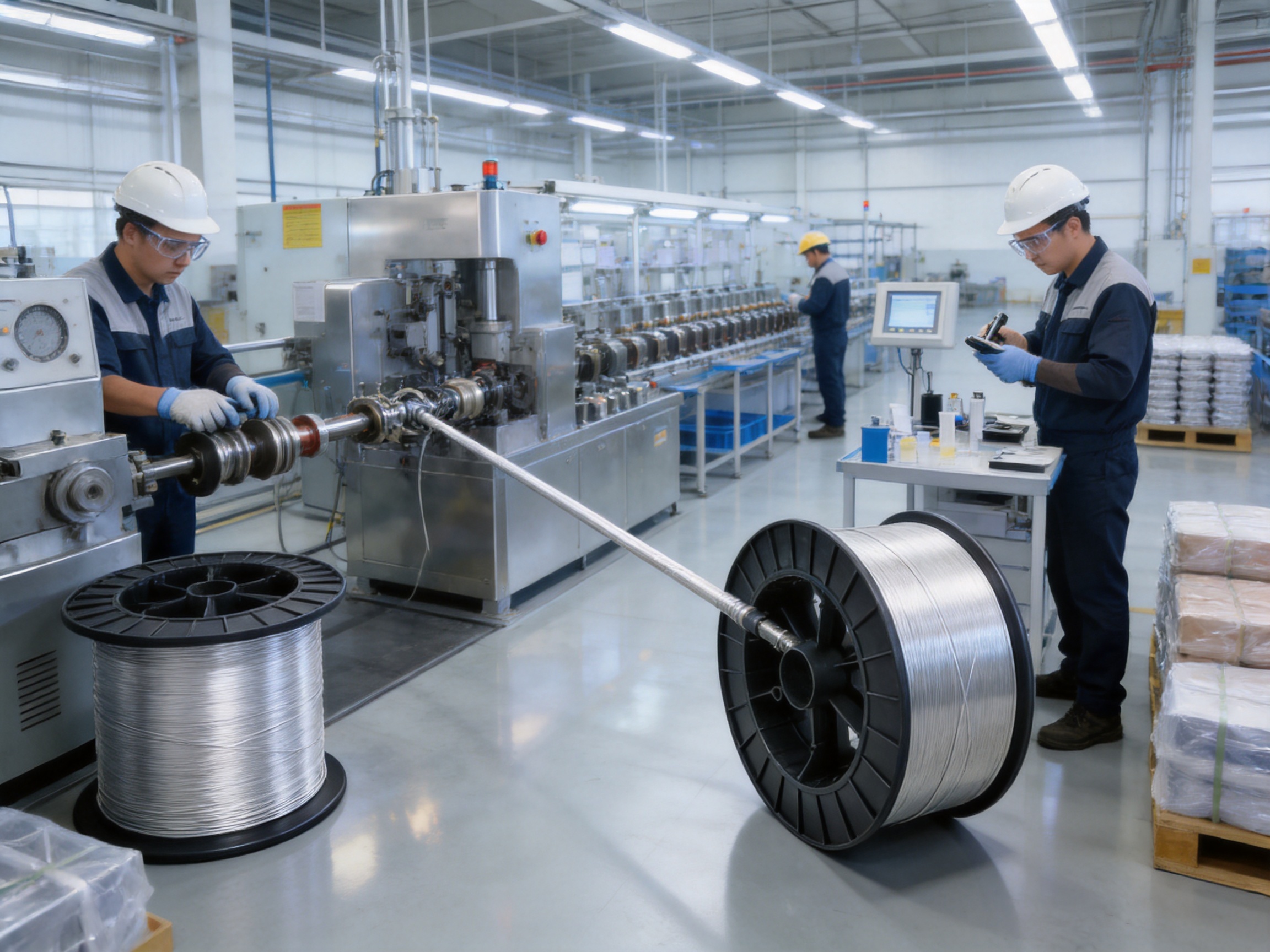
The transformation from aluminum rod or alloy feedstock into finished wire requires control at multiple stages. Drawing operations must reduce the material to the specified diameter without creating excessive surface damage or dimensional instability. Equipment alignment, lubrication control, drawing speed, and die condition can all influence the result.
Where heat treatment or intermediate processing is required, the temperature cycle must be controlled to achieve the intended material condition. Incorrect treatment may affect strength, ductility, feeding performance, or weld behavior. A systematic process approach helps the manufacturer maintain consistency between production batches.
Inspection throughout Production
Quality inspection should not be limited to the final package. Inspection at incoming-material, in-process, and finished-product stages helps detect problems earlier and reduces the risk of nonconforming product reaching the customer.
Typical inspection considerations for aluminum welding wire may include chemical composition, diameter, ovality, surface condition, winding quality, package integrity, and mechanical or welding-related performance where required. The appropriate inspection scope depends on the wire grade, customer specification, applicable standards, and intended application.
Throughout-production inspection also provides process feedback. If a trend is detected, such as increasing dimensional variation or a change in surface appearance, corrective action can be taken before the problem affects a large quantity of product.
Advantages over General-Purpose and Poorly Controlled Alternatives
The main competitive advantage of specialized MIG wire is not a single feature but the combination of material control, manufacturing discipline, inspection, packaging, and application support. Low-cost or poorly controlled wire may appear attractive during purchasing, but hidden costs can arise from feeding interruptions, rework, rejected welds, damaged contact tips, inconsistent appearance, and production downtime.
Compared with inconsistent general-purpose wire, properly controlled aluminum MIG wire offers more predictable behavior. This predictability helps welding engineers establish procedures more efficiently and allows production teams to maintain stable settings. In high-volume manufacturing, even a small reduction in interruptions can create a meaningful improvement in total operating cost.
Specialized production also provides greater flexibility. A manufacturer focused on aluminum wire can develop products for high-purity applications, high-strength alloy applications, and welding-material applications. This breadth allows the supplier to understand the differences between conductive wire, structural alloy wire, and consumable welding wire rather than treating all aluminum products as interchangeable.
Another advantage is the ability to support international customers. Products exported to overseas markets must be manufactured, packaged, documented, and handled with attention to different customer requirements. A company with established quality systems and experience serving high-end markets is better positioned to coordinate these expectations.
However, product selection should always remain technically responsible. No welding wire can compensate for incorrect joint preparation, contaminated base metal, poor shielding, unsuitable equipment, or inadequate operator training. The value of a high-quality product is realized when it is used within a properly controlled welding procedure.
Recommended Welding and Handling Practices
Prepare the Base Material
Before welding, remove oil, grease, moisture, paint, dirt, and other contaminants from the joint area. Aluminum oxide should be managed using an appropriate cleaning method that does not introduce additional contamination. Dedicated tools should be used where necessary to prevent transfer of steel particles or other foreign material onto the aluminum surface.
Use Suitable Shielding Gas
Argon is commonly used for aluminum MIG welding because it supports arc stability and effective shielding. Gas flow must be appropriate for the torch, nozzle, joint design, welding position, and surrounding conditions. Excessive gas flow can create turbulence, while insufficient flow can allow atmospheric contamination to enter the weld pool.
Check the Feeding System
Aluminum wire requires a feeding system designed to handle a relatively soft electrode. Drive-roll pressure should be sufficient to feed the wire without crushing it. The liner, contact tip, and torch cable should be checked regularly for wear, blockage, and incorrect sizing.
The spool should rotate smoothly and be aligned with the feeder. Excessive resistance at the spool can cause feeding instability. Operators should also verify that the wire is correctly positioned in the drive rolls before beginning production.
Control Welding Parameters
Current, voltage, wire feed speed, travel speed, inductance, torch angle, and contact-tip-to-work distance all influence the weld. Parameter selection should be based on the base-material thickness, alloy combination, joint configuration, welding position, and required bead profile.
Because aluminum dissipates heat quickly, the operator may need to use appropriate preheating or heat-input control for certain applications. Any preheating practice must be established according to the base material and approved welding procedure. The goal is to achieve adequate fusion without producing excessive distortion or undesirable metallurgical effects.
Protect the Wire during Storage
Store MIG wire in its original sealed package until it is needed. Keep it away from water, high humidity, dust, chemicals, and direct exposure to damaging environmental conditions. Once opened, protect unused wire from contamination and reseal it whenever possible.
Storage discipline is especially important for aluminum welding wire because moisture and surface contamination can contribute to hydrogen-related porosity. The wire should be loaded into the feeder only when the welding system is ready for use.
Industrial Applications
Transportation Manufacturing
Aluminum is widely used in vehicle bodies, trailers, rail equipment, marine structures, and selected aerospace-related components because of its low density and corrosion resistance. MIG wire supports the joining of panels, frames, brackets, tanks, and structural sections.
Transportation manufacturers often require repeatable welding, controlled distortion, attractive appearance, and efficient production. Consistent wire feeding and alloy compatibility are particularly important where many repeated joints must be completed on a production line.
Industrial Equipment
Industrial machinery manufacturers use aluminum for frames, guards, housings, heat-management components, and lightweight structural assemblies. MIG welding provides a practical method for joining both thin and medium-thickness aluminum sections when the equipment and wire are properly matched.
In this sector, weld quality can influence dimensional accuracy, vibration resistance, corrosion performance, and service life. A stable consumable helps production teams maintain repeatable procedures across different equipment models.
Energy and Electrical Equipment
Aluminum’s conductivity and relatively low weight make it useful in electrical and energy-related products. Welding wire may be used in enclosures, supports, frames, cooling components, and other assemblies where aluminum joining is appropriate.
Applications involving electrical conductivity may place additional importance on material cleanliness and alloy selection. The finished weld should be evaluated according to the electrical, mechanical, and environmental requirements of the product.
Architectural and Construction Products
Aluminum structures and architectural components often require a combination of appearance, corrosion resistance, light weight, and dimensional control. MIG wire can be used for frames, panels, supports, railings, and custom fabricated structures.
Visible welds may require additional finishing or inspection. A consistent wire and a well-controlled procedure can help reduce surface irregularities and support a more uniform appearance before finishing operations such as grinding, polishing, or coating.
General Fabrication
Repair shops, metal service centers, equipment manufacturers, and custom fabricators use aluminum MIG wire for a wide range of jobs. These may include brackets, containers, frames, platforms, fixtures, and maintenance work. In such environments, product versatility and dependable availability are often as important as maximum deposition rate.
Quality Factors for Purchasing Decisions
Purchasers should evaluate aluminum MIG wire using more than unit price. A complete assessment should include the total cost of welding, which may involve consumable usage, operator time, machine downtime, rejected parts, rework, contact-tip replacement, and inventory management.
Important purchasing questions include:
Is the wire chemistry suitable for the base material and service environment?
Does the manufacturer control diameter, ovality, surface condition, and winding quality?
Is the packaging suitable for transportation and storage?
Can the supplier provide batch identification and relevant inspection documentation?
Does the supplier maintain a recognized quality management system?
Can the supplier support repeat orders with consistent product performance?
Is technical communication available when the customer needs help with product selection or welding trials?
Jiangsu Hetuo Aluminum Wire Co., Ltd. addresses these considerations through its specialized product range, manufacturing infrastructure, technical personnel, quality inspection system, and international-market orientation. Customers can discuss product grade, diameter, spool format, packaging, documentation, and application requirements before placing an order.
Product Selection Guide
| Selection Factor | Why It Matters | Customer Information to Provide |
|---|---|---|
| Base aluminum alloy | Determines compatibility, weldability, strength, and corrosion considerations. | Alloy designation, material certificate, or known application. |
| Material thickness | Influences wire diameter, current range, heat input, and deposition requirements. | Thickness range and joint design. |
| Welding process | Defines feeder, torch, shielding gas, and consumable requirements. | MIG or GMAW equipment type and production method. |
| Wire diameter | Affects feeding stability, current capacity, and weld deposition rate. | Required diameter and equipment compatibility. |
| Spool format | Ensures the wire fits the feeder and supports efficient production. | Spool size, weight, arbor dimensions, and winding preference. |
| Operating environment | May influence corrosion resistance and filler alloy selection. | Indoor, outdoor, marine, chemical, thermal, or other service conditions. |
| Quality documentation | Supports procurement control, traceability, and customer audits. | Required certificates, inspection reports, and batch records. |
| Production volume | Determines supply planning, packaging quantities, and delivery expectations. | Trial quantity, monthly demand, and forecast schedule. |
Why Supplier Capability Matters
Welding wire is a production-critical material. If supply is delayed or performance varies significantly between batches, the effect may extend beyond the welding department. It can affect production schedules, inspection results, delivery commitments, and customer satisfaction.
A capable supplier should therefore offer more than a product catalog. The supplier should understand manufacturing requirements, maintain consistent production controls, communicate clearly, and respond to technical or commercial questions. The ability to provide stable repeat orders is particularly important for customers that have qualified a specific welding procedure and need to maintain consistent consumable behavior.
Jiangsu Hetuo Aluminum Wire Co., Ltd. combines aluminum-focused manufacturing with an organized quality management approach. Its technical and management personnel support process control and customer communication, while its factory infrastructure allows the company to manufacture and prepare products for a variety of industrial requirements.
The company’s location in the Economic Development Zone of Guannan County, Lianyungang City, Jiangsu Province, provides an established industrial setting for manufacturing and logistics. Its products are exported to high-end overseas markets, demonstrating an orientation toward international quality expectations and cross-border supply.
Environmental and Sustainability Considerations
Aluminum is recognized for its low density, recyclability, and ability to support lightweight product design. When used appropriately, aluminum can help reduce the material weight of vehicles, equipment, structures, and components. Lower weight may contribute to lower energy consumption during transportation and operation.
Efficient welding also supports sustainability. A stable wire can reduce rework, rejected assemblies, excessive spatter, and unnecessary consumable waste. Better process consistency helps manufacturers use materials more effectively and reduces the energy and labor associated with correcting defective welds.
Responsible sustainability claims should consider the entire product life cycle, including raw material production, processing energy, packaging, transportation, use, repair, and recycling. The manufacturer’s role is to provide reliable aluminum wire and welding materials that enable customers to build durable products and operate efficient fabrication processes.
Common Causes of MIG Welding Problems
Porosity
Porosity may result from moisture, oil, dirt, inadequate shielding, excessive gas turbulence, contaminated base metal, or unsuitable welding technique. Wire quality and storage condition are important, but the entire welding system must be examined when porosity occurs.
Feeding Interruptions
Feeding problems can arise from excessive drive-roll pressure, a worn liner, an incorrect contact tip, spool resistance, damaged wire, poor winding, or excessive torch bending. Because aluminum wire is relatively soft, the feeder must be configured carefully.
Lack of Fusion
Lack of fusion may be associated with insufficient heat input, excessive travel speed, incorrect torch angle, poor joint preparation, or oxide contamination. The operator should verify the welding procedure and surface preparation before attributing the problem to the consumable.
Cracking
Cracking can be influenced by alloy chemistry, joint design, restraint, heat input, dilution, and solidification behavior. Filler selection should be based on technical compatibility with the base alloy and the service requirements. When the application is safety-critical, welding procedure qualification and expert engineering review are essential.
Irregular Bead Shape
Uneven bead shape may be caused by unstable wire feed, incorrect voltage or wire feed speed, inconsistent travel speed, poor shielding, or an unsuitable torch position. A controlled wire helps reduce one potential source of variation, but operator technique and equipment setup remain essential.
Application Support and Customer Cooperation
Successful welding-material supply is based on cooperation between the manufacturer and the customer. Before production begins, the customer should explain the base material, application, welding equipment, expected volume, quality requirements, and delivery schedule. This information helps the supplier prepare an appropriate product and identify any special requirements.
For a new application, customers should conduct welding trials before committing to full-scale production. Trial results may be evaluated through visual inspection, dimensional checks, mechanical testing, nondestructive examination, or other methods required by the project. The results should be recorded and used to establish a repeatable welding procedure.
For established applications, maintaining the same wire specification and procurement controls can help preserve process stability. Changes in wire diameter, alloy, spool format, or supplier should be reviewed before implementation. Even apparently minor changes may require adjustments to the feeder, contact tip, welding parameters, or inspection plan.
Frequently Asked Questions
What is MIG wire?
MIG wire is a continuous metal electrode used in Metal Inert Gas welding. During the welding process, the wire melts and becomes filler metal in the joint. For aluminum applications, it is manufactured from aluminum or aluminum alloy and used with an appropriate shielding gas and welding system.
What is the primary use of aluminum MIG wire?
It is mainly used as a melting electrode for argon-shielded arc welding of aluminum and aluminum alloy components. The exact application depends on the wire alloy, diameter, base material, joint design, and welding procedure.
Can one wire grade be used for every aluminum alloy?
No. Aluminum alloys have different chemical and mechanical characteristics. The filler wire should be selected according to base-metal compatibility, required strength, corrosion resistance, weldability, and service conditions.
Why is surface cleanliness important?
Contamination and moisture can contribute to porosity, inclusions, unstable arc behavior, and poor weld appearance. Both the base metal and the wire should be kept clean and dry throughout storage and use.
Why does wire diameter matter?
Wire diameter affects feeding, current capacity, deposition rate, and suitability for different material thicknesses. The diameter must be compatible with the welding machine, torch, contact tip, and production requirements.
What makes aluminum wire difficult to feed?
Aluminum wire is relatively soft compared with many steel wires. Excessive drive-roll pressure, an incorrect liner, a worn contact tip, tight torch bends, poor spool alignment, or inconsistent wire dimensions can cause feeding problems.
How should MIG wire be stored?
Keep it in its original sealed package in a clean, dry environment. Protect it from moisture, dust, chemicals, impact, and condensation. Open the package only when the material is ready to be used.
Does high-quality wire eliminate welding defects?
No. Wire quality is important, but defects may also result from poor surface preparation, incorrect parameters, inadequate shielding, equipment problems, joint design, or operator technique. The entire welding process must be controlled.
What quality systems support the company’s manufacturing?
Jiangsu Hetuo Aluminum Wire Co., Ltd. has obtained ISO 9001 and IATF 16949 quality management system certifications. These systems support documented processes, customer focus, process control, defect prevention, and continual improvement.
What products does the company manufacture?
The company specializes in high-purity aluminum wire, high-strength aluminum alloy wire, and aluminum and aluminum alloy welding materials. Its product portfolio includes aluminum-based wires and related materials for industrial customers.
Can the wire be used in automated welding?
Aluminum MIG wire can be used in automated or robotic welding when its alloy, diameter, spool format, and surface condition are compatible with the equipment. The customer should verify the consumable through production trials and procedure qualification.
What information should be provided when requesting a quotation?
Customers should provide the required alloy or application, wire diameter, spool format, estimated quantity, base-material grade and thickness, welding process, packaging requirements, destination, documentation needs, and delivery schedule.
Conclusion
MIG wire is a fundamental component of efficient aluminum welding. As a melting electrode used in argon-shielded arc welding, it directly contributes filler metal to the joint and affects arc stability, feeding reliability, bead appearance, deposition efficiency, and production consistency. The best results are achieved when the wire is correctly matched to the base alloy and used within a controlled welding procedure.
Compared with poorly controlled alternatives, specialized aluminum MIG wire offers advantages in dimensional consistency, surface condition, winding quality, repeatability, and compatibility with modern welding equipment. These advantages can reduce interruptions, rework, rejected welds, and total production costs.
Jiangsu Hetuo Aluminum Wire Co., Ltd. combines aluminum-material specialization with an advanced manufacturing system. Its 40,000-square-meter factory, team of professional managers and technicians, advanced equipment, inspection procedures, ISO 9001 certification, and IATF 16949 certification provide a structured foundation for supplying aluminum wire and welding materials. The company’s focus on customer needs and international markets further supports its role as a supplier for industrial users seeking dependable aluminum-based products.
For the best outcome, buyers should evaluate alloy compatibility, wire diameter, surface condition, spool design, packaging, quality documentation, and supplier consistency. With the correct product and a properly managed welding process, MIG wire can help manufacturers produce lighter, stronger, cleaner, and more efficient aluminum assemblies.
References
American Welding Society. Welding Handbook, Volume 1: Welding Science and Technology.
American Welding Society. Specification for Aluminum and Aluminum-Alloy Electrodes for Gas Metal Arc Welding.
International Organization for Standardization. ISO 9001: Quality Management Systems—Requirements.
International Automotive Task Force. IATF 16949: Quality Management System Requirements for Automotive Production and Relevant Service Parts Organizations.
International Organization for Standardization. Welding and Allied Processes—Guidance on Quality Requirements for Fusion Welding.
ASM International. ASM Handbook, Volume 6A: Welding Fundamentals and Processes.
Aluminum Association. Aluminum Standards and Data.