

 English
 中文简体
中文简体 русский
 Deutsch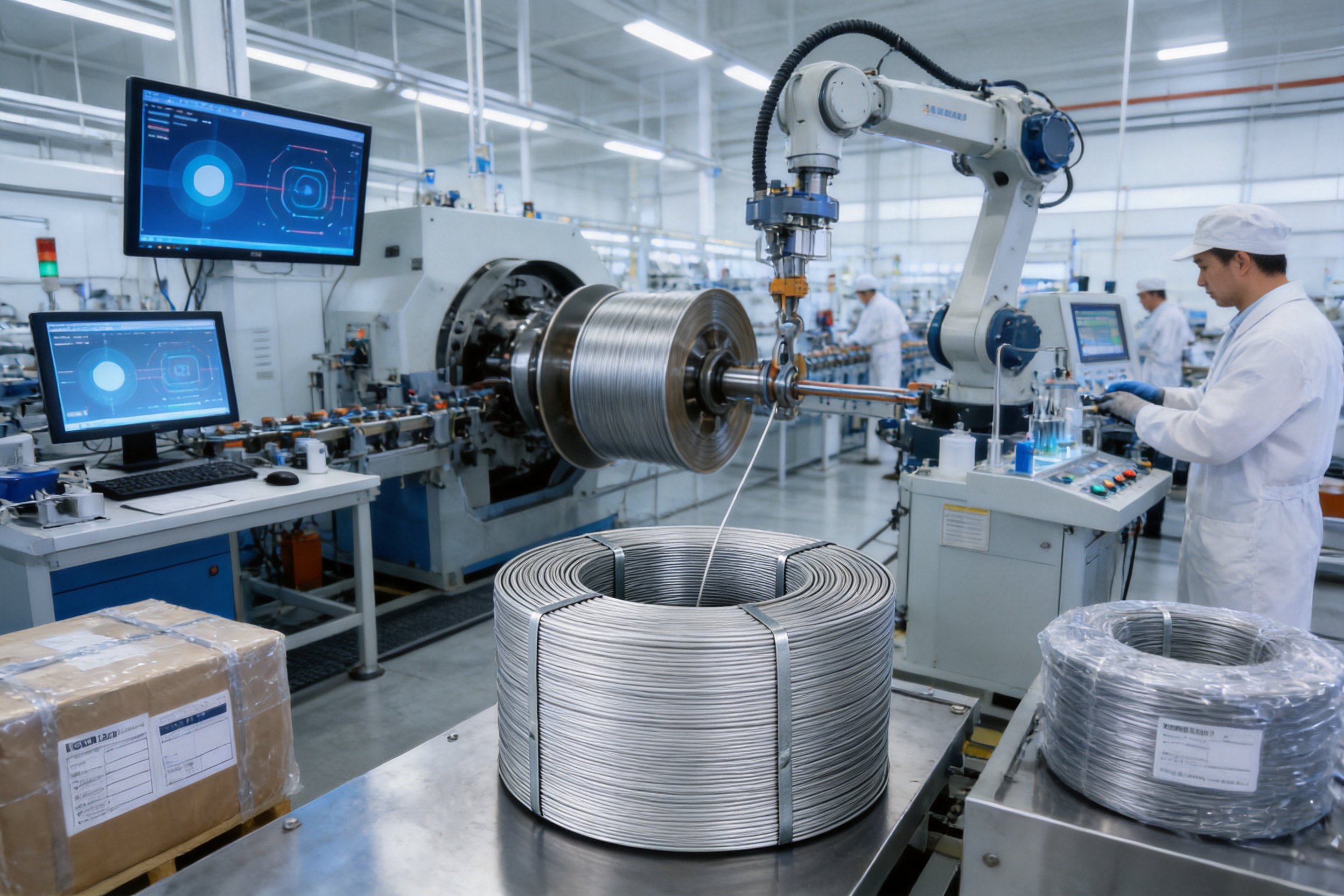
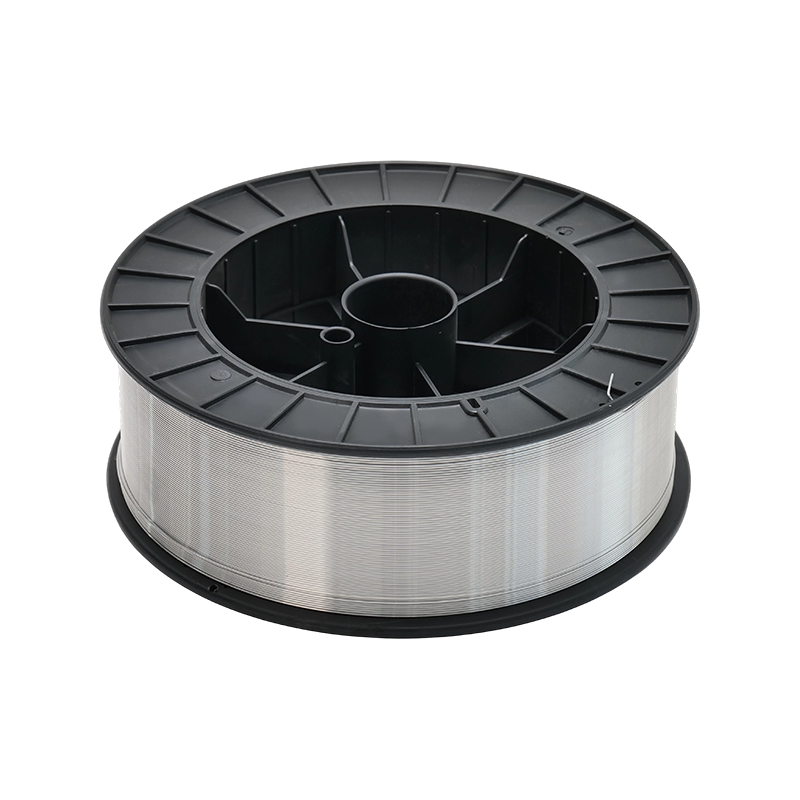
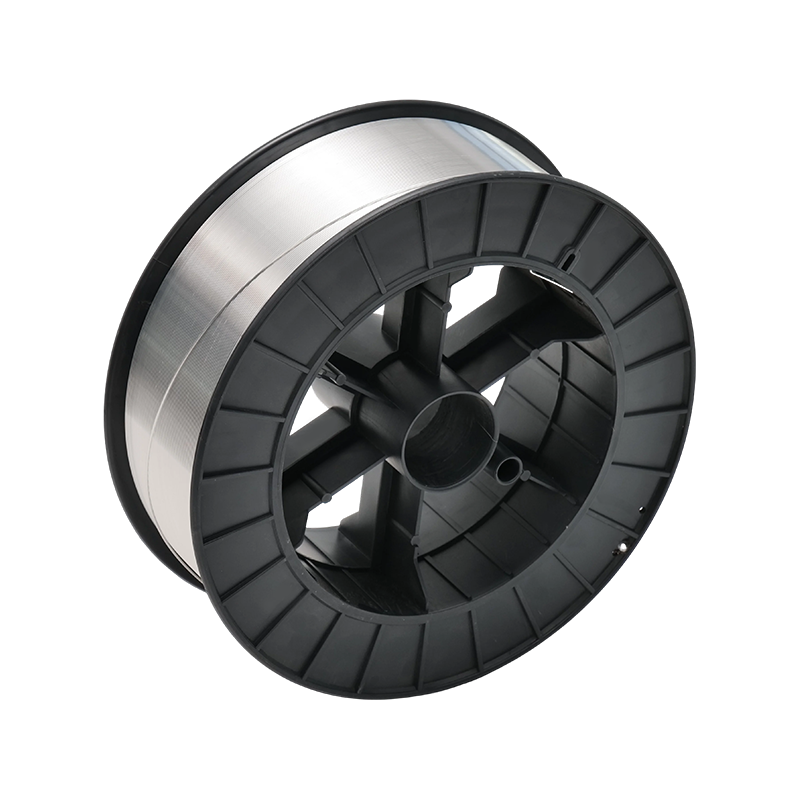
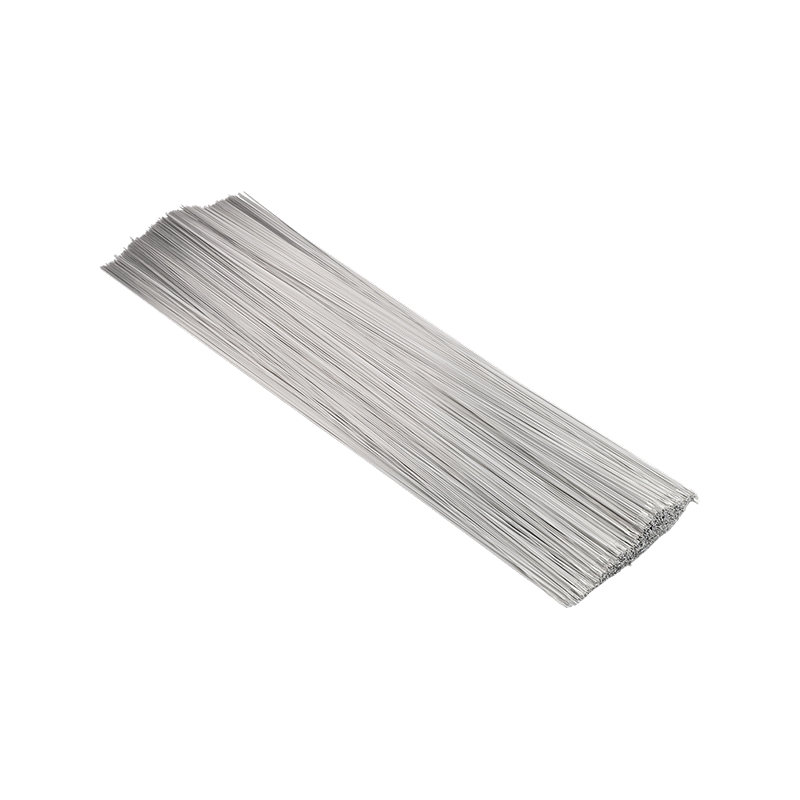
AlMg6 aluminum alloy wire is a high-strength aluminum-magnesium wire designed for demanding industrial applications where strength, corrosion resistance, weldability, and reduced weight must work together. It is used mainly in aviation, aerospace, military equipment, ships, automobiles, tanks, and other engineered structures that require dependable aluminum alloy materials.
With a magnesium content of approximately 5.8% to 6.8%, AlMg6 belongs to the high-magnesium aluminum alloy family. The alloy also contains controlled quantities of silicon, iron, copper, manganese, zinc, titanium, beryllium, and other elements. This carefully balanced composition gives the wire a useful combination of mechanical performance, exfoliation corrosion resistance, weldability, and suitability for advanced fabrication processes.
Jiangsu Hetuo Aluminum Wire Co., Ltd. manufactures AlMg6 aluminum alloy wire as part of its high-strength aluminum alloy wire product range. The company operates an intelligent manufacturing system covering high-purity aluminum wire, high-strength aluminum alloy wire, and aluminum and aluminum alloy welding materials. Its production capabilities, quality systems, technical personnel, and specialized facilities support the requirements of customers in transportation, defense, marine engineering, aerospace, and industrial manufacturing.
Content
- 1 What Is AlMg6 Aluminum Alloy Wire?
- 2 Typical Chemical Composition
- 3 Key Advantages of AlMg6 Aluminum Alloy Wire
- 4 Comparison with Other Aluminum Alloy Wire Grades
- 5 Applications in Aviation and Aerospace
- 6 Applications in Military Equipment and Tanks
- 7 Applications in Shipbuilding and Marine Engineering
- 8 Applications in Automobiles and Transportation Equipment
- 9 Manufacturing Strengths and Production Capability
- 10 Quality Control for AlMg6 Aluminum Alloy Wire
- 11 Recommended Storage and Handling
- 12 Welding and Fabrication Considerations
- 13 Why Choose a Specialized Manufacturer?
- 14 Advantages Over Low-Quality or Uncontrolled Alternatives
- 15 Ordering Information and Customer Evaluation
- 16 Environmental and Sustainability Considerations
- 17 Technical Summary
- 18 Q&A About AlMg6 Aluminum Alloy Wire
- 18.1 What is the main alloying element in AlMg6?
- 18.2 What are the principal advantages of AlMg6 wire?
- 18.3 Is AlMg6 suitable for welding?
- 18.4 How does AlMg6 compare with 5356 aluminum alloy wire?
- 18.5 How does AlMg6 compare with 4043?
- 18.6 Is AlMg6 resistant to all forms of corrosion?
- 18.7 What industries use AlMg6 aluminum alloy wire?
- 18.8 What quality certifications does the manufacturer have?
- 18.9 What should customers confirm before purchasing?
- 18.10 How should AlMg6 wire be stored?
- 18.11 Can the manufacturer support other aluminum wire grades?
- 19 Conclusion
- 20 References
- 21 Product: AlMg6 Aluminum Alloy Wire
What Is AlMg6 Aluminum Alloy Wire?
AlMg6 aluminum alloy wire is an aluminum-magnesium alloy wire in which magnesium is the principal strengthening element. The alloy is formulated with aluminum as the balance and magnesium at a relatively high level compared with lower-magnesium grades such as AlMg3 and AlMg5. The increased magnesium content contributes to higher strength while maintaining the low density and corrosion-resistant characteristics associated with aluminum alloys.
The wire may be supplied for structural fabrication, welding-related operations, component production, or other applications requiring a strong and corrosion-resistant aluminum alloy feedstock. The final suitability of the wire depends on factors such as diameter, temper, surface condition, dimensional tolerance, packaging, welding process, base-metal grade, and customer specifications.
Unlike ordinary commercial aluminum wire, AlMg6 is not selected solely for electrical conductivity or general-purpose forming. It is selected when a project needs a more capable aluminum alloy with improved strength and better resistance to aggressive environments. This makes it particularly useful for equipment exposed to moisture, salt spray, vibration, impact, changing temperatures, or demanding service loads.
The wire is also suitable for projects where weight reduction is important. Aluminum has a substantially lower density than steel, so an aluminum alloy wire can contribute to lighter assemblies while maintaining an appropriate level of strength. In transportation and aerospace applications, lower weight can improve payload capacity, energy efficiency, acceleration, range, or overall system performance.
Typical Chemical Composition
The stated chemical composition of AlMg6 aluminum alloy wire is shown below. The values represent the product information provided for this grade. Exact acceptance limits should be confirmed against the applicable purchase specification, technical data sheet, or mill test certificate for each order.
| Element | Specified Content | Function in the Alloy |
|---|---|---|
| Silicon (Si) | 0.40% | Controlled as an impurity or alloying constituent; affects melting and solidification behavior. |
| Iron (Fe) | 0.40% | Kept under control because excessive iron can affect ductility and constituent phases. |
| Copper (Cu) | 0.10% | Maintained at a low level to support corrosion resistance and weldability. |
| Manganese (Mn) | 0.5%–0.8% | Contributes to strength and helps control the alloy microstructure. |
| Magnesium (Mg) | 5.8%–6.8% | Primary strengthening element and a major contributor to the alloy’s performance. |
| Zinc (Zn) | 0.20% | Controlled in support of composition stability and corrosion performance. |
| Titanium (Ti) | 0.1%–0.2% | May assist grain refinement and compositional control. |
| Beryllium (Be) | 0.002%–0.005% | Present at a tightly controlled trace level in the stated composition. |
| Other elements | Single: 0.05%; Total: 0.15% | Limits minor and residual elements. |
| Aluminum (Al) | Balance | Base metal providing low density, conductivity, and the aluminum alloy matrix. |
The composition demonstrates why AlMg6 is positioned as a high-strength alloy wire rather than a basic aluminum product. Magnesium is present at a higher level than in AlMg3, AlMg5, AlMg61, 5154, 5183, and 5356 grades listed in the supplied product information. This higher magnesium content is one of the principal reasons customers may choose AlMg6 for applications needing additional alloy strength and robust service performance.
Composition control is particularly important for aluminum alloy wire because small changes in alloying elements can influence melting behavior, wire drawing response, surface quality, weld-pool behavior, corrosion resistance, and final mechanical properties. A stable chemical composition helps manufacturers maintain repeatability from batch to batch and allows customers to establish more consistent production parameters.
Key Advantages of AlMg6 Aluminum Alloy Wire
High Strength with Low Weight
The principal advantage of AlMg6 is its strength-to-weight balance. Magnesium strengthens the aluminum matrix, allowing the alloy to deliver higher performance than commercially pure aluminum wire while retaining aluminum’s low-density advantage. This is valuable in vehicles, aircraft, ships, armored equipment, and machinery where every kilogram can affect operating efficiency.
In lightweight structures, material selection is rarely based on tensile strength alone. Designers also consider density, fatigue exposure, corrosion, weldability, maintenance requirements, and manufacturing cost. AlMg6 provides a practical balance across these factors. It can help reduce structural mass without requiring the complete redesign of a component around a heavier steel material.
For automotive and transportation manufacturers, the use of a strong aluminum-magnesium wire can support lightweight body structures, tanks, frames, brackets, enclosures, and repair or joining operations. In aerospace and defense applications, high strength combined with lower weight may support mobility, fuel economy, payload efficiency, and equipment portability.
Good Exfoliation Corrosion Resistance
AlMg6 is described as having good exfoliation corrosion resistance. Exfoliation corrosion is a form of localized corrosion that can occur in susceptible aluminum alloys, particularly when the material is exposed to moisture, salts, contaminants, or cyclic environmental conditions. It often follows the grain structure and may cause layered lifting or flaking of the surface.
Resistance to this type of corrosion is important in aircraft, ships, military vehicles, marine structures, and transportation equipment. These applications may experience humid atmospheres, saltwater, deicing chemicals, industrial contaminants, or repeated wet-and-dry cycles. A material with suitable corrosion resistance can help extend service life and reduce inspection, repair, and replacement requirements.
Corrosion performance is influenced by more than chemical composition. Surface condition, heat treatment, residual stress, joint design, galvanic contact, coating systems, contaminants, and service environment all play important roles. Therefore, AlMg6 should be integrated into a complete corrosion-control strategy rather than treated as a substitute for appropriate design, cleaning, protective coatings, or inspection.
Good Weldability
AlMg6 is also valued for good weldability. This characteristic allows it to be considered for welded structures and fabrication processes where the wire must melt consistently, form an acceptable weld pool, and produce a sound joint under controlled operating conditions.
Good weldability is particularly important for large aluminum structures. Ships, tanks, vehicle bodies, transportation frames, pressure-related assemblies, and aerospace components may require extensive joining. A wire that is compatible with the base material and welding process can help reduce defects, improve production stability, and support predictable joint quality.
Weldability depends on the relationship between the wire and the base alloy. The selection process should consider base-metal chemistry, welding method, joint geometry, shielding gas, current, voltage, travel speed, pre-cleaning, interpass temperature, and post-weld inspection. The same wire may perform differently when used with different base materials or equipment.
Suitable for Demanding Industrial Environments
The combination of strength, corrosion resistance, weldability, and low density allows AlMg6 to serve in demanding industrial environments. It is suitable for customers who need more than the general-purpose performance of pure aluminum or lower-alloyed aluminum wire.
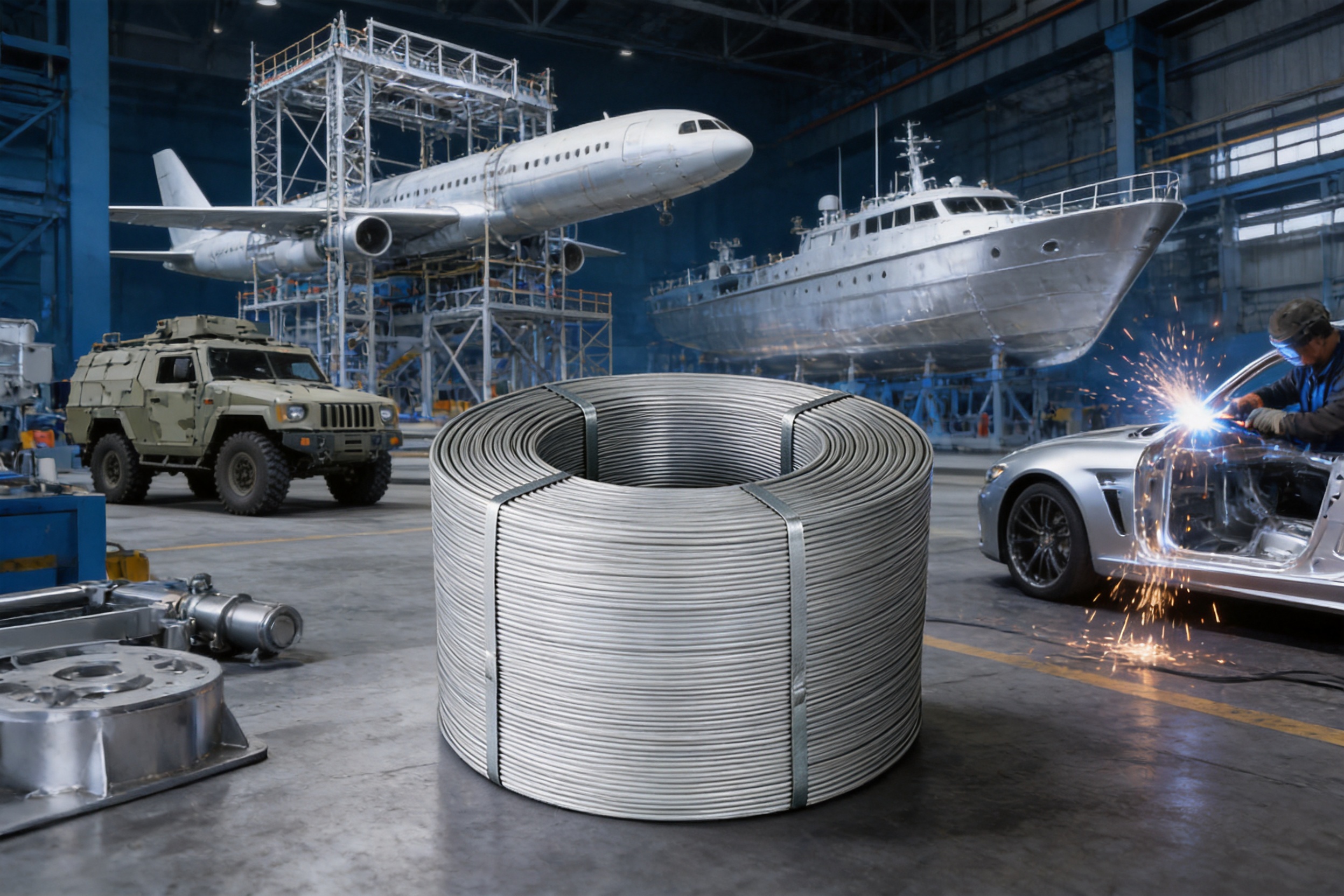
In aviation and aerospace, the alloy can be considered for selected structural, fabrication, repair, or joining applications where material certification and process qualification are essential. In marine engineering, the alloy’s corrosion-resistant characteristics are relevant to vessels, marine equipment, and components exposed to humid or salt-containing environments. In military and tank manufacturing, weight savings and structural performance may be important alongside durability and field serviceability.
In automotive manufacturing, aluminum alloy wire can support lightweight construction, joining, component repair, and specialized fabrication. The exact application should be confirmed through engineering evaluation, especially where the wire is used in safety-critical structures.
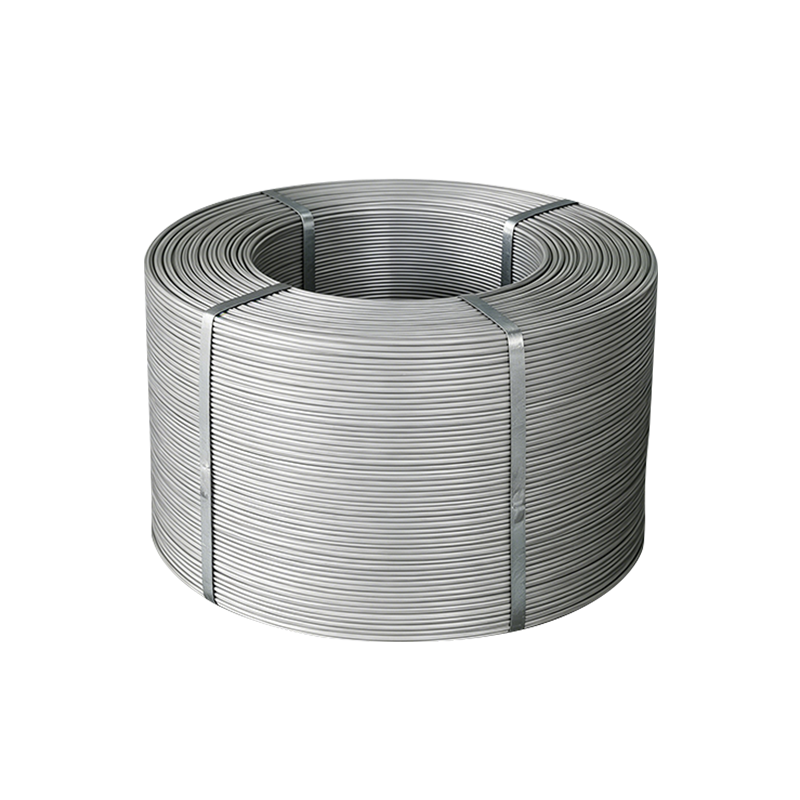
AlMg6 Aluminum Alloy Wire
Comparison with Other Aluminum Alloy Wire Grades
AlMg6 is one of several aluminum alloy wire grades available for industrial and welding applications. The most appropriate grade depends on the desired combination of strength, fluidity, crack resistance, corrosion behavior, color matching, machinability, and compatibility with the base metal.
| Grade | Main Alloying Characteristics | General Position Compared with AlMg6 |
|---|---|---|
| AlMg3 | Magnesium approximately 3.2%–3.8% | Lower magnesium content and generally selected where moderate strength or different forming and joining characteristics are sufficient. |
| AlMg5 | Magnesium approximately 4.8%–5.8% | Similar aluminum-magnesium family, but with a lower stated magnesium range than AlMg6. |
| AlMg61 | Magnesium approximately 5.5%–6.5%, with higher manganese range in the supplied table | Close in magnesium content; selection depends on the required composition, trace-element limits, and application specification. |
| 5154 | Magnesium approximately 3.1%–3.9% | Lower magnesium content and suitable for applications requiring a different strength and corrosion-performance balance. |
| 5183 | Magnesium approximately 4.3%–5.2% | Widely considered in aluminum welding applications; AlMg6 offers a higher stated magnesium range. |
| 5356 | Magnesium approximately 4.5%–5.5% | A common aluminum-magnesium wire grade; AlMg6 may be preferred when the specified higher magnesium range is required. |
| 4043 | Silicon approximately 4.5%–6.0% | Silicon-based alloy wire with different fluidity, solidification, and weld-metal characteristics. |
| 4047 | Silicon approximately 11.0%–13.0% | High-silicon wire selected for particular melting and joining requirements rather than high-magnesium performance. |
| 2219 | Copper approximately 5.8%–6.8% | Copper-based aluminum alloy with a different strength, thermal, and corrosion-performance profile. |
The comparison shows that AlMg6 occupies a distinct position. Compared with AlMg3, AlMg5, 5154, 5183, and 5356, it has a higher stated magnesium range. Compared with 4043 and 4047, it is a magnesium-based alloy rather than a silicon-based alloy. Compared with 2219, it relies on magnesium rather than copper as the principal alloying element.
This does not mean that AlMg6 is universally superior to every other grade. Each alloy has a specific engineering purpose. For example, a silicon-based filler wire may be selected for its melting behavior or crack-resistance characteristics in a particular joint, while a magnesium-based wire may be selected for higher strength or compatibility with a magnesium-containing base alloy. The advantage of AlMg6 is its suitability for applications that specifically require its high-magnesium composition and associated performance balance.
Applications in Aviation and Aerospace
Aerospace structures demand materials that combine low weight, strength, corrosion resistance, consistency, and traceability. AlMg6 aluminum alloy wire can be considered for suitable fabrication and joining applications where aluminum-magnesium chemistry is appropriate and where the wire meets the required aerospace specification.
Weight reduction is a central design objective in aircraft and aerospace equipment. A lighter structure can reduce fuel or energy consumption, improve range, and increase payload potential. Aluminum alloy wire may be used in the manufacture, repair, or joining of selected panels, frames, brackets, housings, and structural assemblies.
Aerospace use requires strict control of material quality. The wire should be supplied with reliable batch identification, composition documentation, dimensional records, and any required mechanical or surface inspection data. Welding procedures must be qualified, operators must be trained, and finished joints must be inspected according to the relevant design and regulatory requirements.
AlMg6’s reported exfoliation corrosion resistance is also relevant to aircraft exposed to humidity, atmospheric contaminants, and changing environmental conditions. Nevertheless, aerospace engineers must evaluate the complete material system, including heat-affected zones, joint geometry, protective treatments, fastener compatibility, and galvanic corrosion risks.
Applications in Military Equipment and Tanks
Military vehicles and tanks often require a combination of mobility, protection, durability, and repairability. Aluminum alloy construction can reduce vehicle mass and support improved transportability, fuel efficiency, and maneuverability. A high-strength aluminum alloy wire such as AlMg6 can be used in suitable manufacturing or maintenance operations where its composition and welding performance match the base materials.
The wire may support the production or repair of frames, enclosures, structural sections, brackets, access panels, storage systems, and other aluminum components. Its corrosion resistance is useful for equipment that may operate in wet, coastal, dusty, or chemically contaminated environments.
Military applications also place strong demands on reliability and supply continuity. Manufacturers need stable production, controlled raw materials, repeatable quality, and responsive technical support. A supplier with an integrated aluminum wire and welding-material production system can help customers reduce the complexity of sourcing related products from multiple vendors.
As with aerospace work, safety-critical defense applications require formal qualification. The wire should be evaluated against the applicable military, national, customer, and project standards before being introduced into production.
Applications in Shipbuilding and Marine Engineering
Aluminum alloys are widely used in marine applications because of their low density and useful resistance to atmospheric and marine exposure. AlMg6 aluminum alloy wire can be considered for suitable shipbuilding and marine engineering applications involving aluminum structures, fabricated sections, equipment supports, and repair work.
Weight savings are especially valuable in vessels. Reducing structural weight can improve speed, fuel economy, payload, stability, or maneuverability. Aluminum welding materials must also provide consistent feeding, clean melting behavior, and reliable joint formation during long production runs.
Marine environments present special corrosion challenges. Saltwater, spray, immersion, dissimilar-metal contact, and retained moisture can accelerate corrosion. The use of AlMg6 should therefore be combined with correct joint design, surface preparation, drainage, coating, insulation, and maintenance procedures.
Its good exfoliation corrosion resistance provides a useful material advantage, but it should not be interpreted as complete immunity to marine corrosion. Proper welding practice and environmental protection remain necessary for long-term performance.
Applications in Automobiles and Transportation Equipment
Automobile manufacturers continue to seek lightweight materials that can meet strength and durability requirements. Aluminum alloy wire can contribute to the production of lightweight body structures, frames, containers, battery-related housings, commercial vehicle components, and transportation equipment.
AlMg6 is particularly attractive when a project needs a stronger aluminum-magnesium wire rather than a general-purpose aluminum filler. The alloy can help support structural efficiency while retaining the mass advantage of aluminum. Its corrosion resistance is also relevant to vehicles exposed to rainwater, road salt, humidity, and temperature cycling.
Transportation manufacturing requires high productivity and repeatable process control. Wire diameter, roundness, surface cleanliness, winding quality, and feeding behavior can influence production efficiency. A stable wire supply helps reduce interruptions, feeding problems, rework, and variation between production batches.
Automotive customers may also value a supplier that understands both aluminum alloy wire and aluminum welding materials. This broader product capability can simplify material selection, technical communication, and supply-chain management for projects involving several aluminum grades.
Manufacturing Strengths and Production Capability
Integrated Aluminum Material Product System
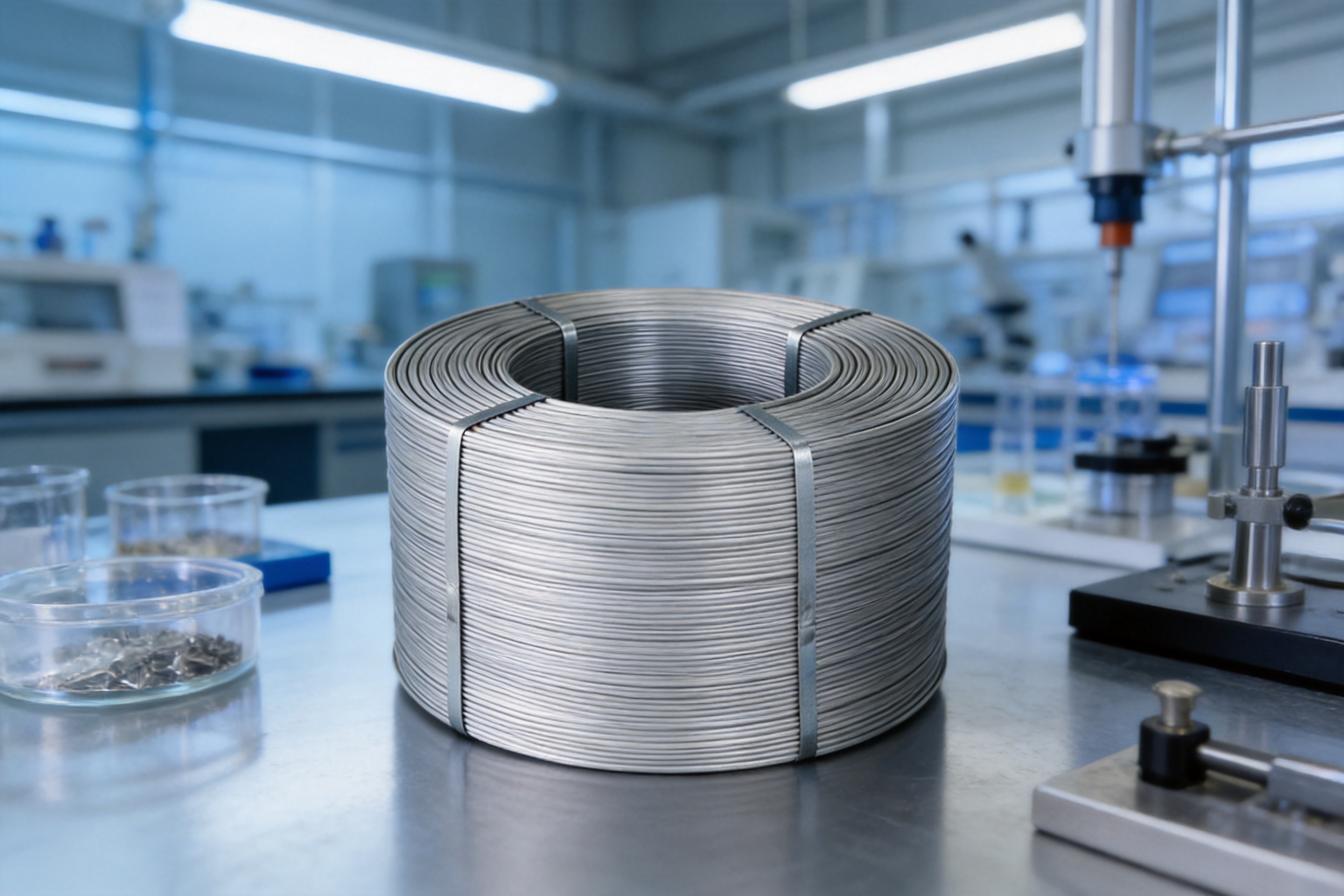
Jiangsu Hetuo Aluminum Wire Co., Ltd. has established a manufacturing system covering high-purity aluminum wire, high-strength aluminum alloy wire, and aluminum and aluminum alloy welding materials. This product structure allows the company to serve customers with different conductivity, strength, fabrication, and welding requirements.
For customers purchasing AlMg6, an integrated product portfolio can be beneficial because aluminum wire products and welding materials often need to be coordinated. Engineering teams may require several grades for one project, while procurement departments may prefer a supplier capable of supporting multiple material categories. The company’s product range is designed to address these connected requirements.
Intelligent Manufacturing Approach
The company describes its production system as intelligent manufacturing. In practice, an intelligent manufacturing approach is intended to improve process visibility, production coordination, equipment management, data collection, and quality traceability. These capabilities are especially valuable for alloy wire, where composition, surface quality, dimensions, and winding condition must remain stable throughout production.
A modern production system can help connect raw-material management, melting or alloy preparation, forming, drawing, finishing, inspection, packaging, and shipment. The specific process route may vary according to the wire grade and order requirements, but the overall objective is to achieve repeatable output and reliable delivery.
Digital and automated controls can also help manufacturers identify process deviations earlier. When production information is recorded systematically, quality personnel can compare batches, investigate nonconformities, and improve process parameters. This supports more consistent supply for customers operating continuous or high-volume manufacturing lines.
Advanced Equipment and Facilities
The company has introduced advanced equipment and facilities for its aluminum alloy products. Appropriate equipment is essential for controlling melting, alloy preparation, casting, rolling, drawing, surface treatment, straightening, winding, and packaging operations. Each stage can influence the final wire’s chemical stability, dimensional accuracy, surface condition, and performance during use.
For high-strength aluminum alloy wire, equipment must be capable of handling the material’s forming characteristics without creating excessive surface damage, dimensional variation, or internal defects. Controlled production conditions help maintain the balance between strength, ductility, surface quality, and customer-specific requirements.
The factory covers approximately 40,000 square meters. This provides space for production equipment, raw-material storage, inspection areas, finished-goods management, logistics, and technical operations. A dedicated industrial site can support organized material flow and scalable production planning.
Experienced Technical and Management Personnel
The company employs approximately 60 people, including 30 professional managers and technicians. This proportion indicates a strong focus on technical management, production organization, quality control, process supervision, and customer support.
Aluminum alloy wire manufacturing requires coordination among metallurgy, equipment operation, process engineering, quality inspection, packaging, and logistics. Experienced technical personnel can help identify the causes of variation, improve production efficiency, manage customer specifications, and support the development of customized products.
Technical expertise is also important when customers need assistance with grade selection. AlMg6 should not be selected only because it has a high magnesium content. The supplier and customer should evaluate the base metal, intended welding process, required mechanical properties, service environment, dimensions, surface condition, and applicable standards. A technically capable manufacturer can contribute more value during this evaluation.
Quality Management Certifications
Jiangsu Hetuo Aluminum Wire Co., Ltd. has obtained ISO 9001 and IATF 16949 quality management system certifications. ISO 9001 provides a structured framework for quality management, process control, customer requirements, corrective action, documentation, and continual improvement. IATF 16949 is associated with the automotive industry and emphasizes process effectiveness, risk management, defect prevention, traceability, and customer-specific requirements.
These certifications are important indicators of the company’s management framework. They do not eliminate the need for product-specific inspection or customer qualification, but they demonstrate that the company has established formal systems for managing quality and production processes.
For automotive and transportation customers, IATF 16949 certification can be particularly relevant. Such customers often require strict control plans, process audits, production-part approval procedures, traceability, and continuous improvement. For aerospace, defense, and marine customers, additional project-specific qualifications may still be required.
Quality Control for AlMg6 Aluminum Alloy Wire
Quality control begins with the selection and verification of raw materials. Aluminum, magnesium, manganese, titanium, and other alloying elements must be controlled to achieve the required chemistry. The supplied composition limits for AlMg6 include both major alloying elements and restrictions on minor or residual elements.
Chemical analysis is used to verify that the alloy falls within the required ranges. Magnesium is especially important because it is the primary strengthening element in AlMg6. Manganese, titanium, beryllium, and residual elements must also remain within their stated limits to support consistent material behavior.
Dimensional inspection is another important part of wire quality. Customers may specify wire diameter, tolerance, ovality, length, winding configuration, or spool dimensions. Consistent dimensions support stable feeding, accurate material consumption, and predictable process settings.
Surface inspection helps identify scratches, cracks, oxidation, contamination, dents, laps, irregularities, or other conditions that could affect handling and welding. Clean and uniform surfaces are important because aluminum oxide, oil, moisture, and foreign materials can influence welding stability and joint quality.
Winding and packaging should protect the wire during storage and transportation. Poor winding can cause tangles, feeding interruptions, deformation, and production downtime. Suitable packaging also helps limit exposure to moisture, dust, impact, and other environmental factors.
Depending on the application, customers may require additional tests such as tensile testing, elongation testing, conductivity measurement, metallographic examination, weldability evaluation, or non-destructive inspection. The final quality-control plan should be agreed upon before production, especially for aviation, aerospace, military, automotive, and marine projects.
Recommended Storage and Handling
AlMg6 aluminum alloy wire should be stored in a clean, dry, and controlled environment. The material should be protected from rain, condensation, standing water, corrosive chemicals, dust, and contact with incompatible materials. Moisture can contribute to surface contamination and may affect welding performance.
Packages should remain sealed or protected until the wire is ready for use. When a package is opened, operators should handle the wire with clean gloves and avoid direct contact with oily or dirty surfaces. Wire should be kept away from carbon-steel dust and other contaminants that may create surface defects or contribute to galvanic corrosion.
Before use, customers should check the package label, grade, batch number, diameter, condition, and documentation. Any visible damage, discoloration, corrosion, or contamination should be evaluated before the wire is introduced into production.
During welding, correct feeding equipment and liner selection are important. Aluminum wire is softer than many steel wires and may require suitable drive-roll pressure, liner design, contact-tip selection, spool alignment, and feeding speed. Welding operators should follow qualified procedures rather than relying on general settings.
Welding and Fabrication Considerations
AlMg6 aluminum alloy wire should be matched carefully with the base material and welding process. The wire chemistry must be suitable for the desired weld-metal properties and the service environment. The choice may be influenced by the possibility of hot cracking, joint strength, corrosion behavior, color matching, ductility, and post-weld treatment.
Aluminum surfaces naturally develop an oxide layer. Proper cleaning is important before welding because oils, moisture, dirt, and oxides can contribute to porosity, lack of fusion, inclusions, or unstable arc behavior. Cleaning methods should be compatible with the base material and the qualified welding procedure.
Shielding gas quality and flow are also important. Inadequate shielding may allow atmospheric contamination into the weld pool, while excessive flow can create turbulence and draw air into the shielding zone. The correct gas, flow rate, torch angle, travel speed, and electrical parameters should be established through process qualification.
Heat input must be controlled to reduce distortion and protect the performance of the heat-affected zone. Aluminum conducts heat rapidly, so joint preparation, preheating where permitted, travel speed, and sequence planning can influence the final result. Large structures may need special clamping and distortion-control measures.
After welding, visual inspection and any required non-destructive testing should be completed. Critical assemblies may require radiographic, ultrasonic, dye-penetrant, or other examinations according to the project specification. The wire itself should not be considered a guarantee of weld quality; joint performance depends on the complete manufacturing system.
Why Choose a Specialized Manufacturer?
Choosing a specialized aluminum wire manufacturer offers advantages over purchasing an unspecified or general-purpose wire. A specialist understands the relationship between chemical composition, wire processing, surface condition, packaging, and customer application requirements.
For AlMg6, specialization is important because the high magnesium content must be controlled accurately. The alloy must be processed in a way that supports stable drawing, suitable surface quality, and consistent delivery. A supplier with experience in high-strength aluminum alloy wire is better positioned to manage these requirements than a supplier focused only on basic aluminum products.
A specialized manufacturer can also support product customization. Depending on production capability and customer agreement, customization may involve wire diameter, spool format, packaging, labeling, inspection documentation, chemical limits, or delivery quantities. Such flexibility is valuable for customers with automated welding lines or specialized fabrication equipment.
Another advantage is supply-chain continuity. Jiangsu Hetuo Aluminum Wire Co., Ltd. produces several categories of aluminum wire and welding materials, allowing customers to coordinate different products through one supplier. This may simplify purchasing, reduce administrative work, and improve communication between technical and procurement teams.
Advantages Over Low-Quality or Uncontrolled Alternatives
AlMg6 wire from a controlled manufacturing system offers several potential advantages over low-quality or poorly documented alternatives. First, verified chemical composition helps ensure that the product is actually within the specified alloy range. Uncontrolled composition can cause unexpected changes in strength, corrosion behavior, weldability, and process stability.
Second, controlled dimensions and winding reduce feeding problems. In automated production, an irregular wire diameter or poorly wound spool can lead to interruptions, inconsistent deposition, and excess scrap. Consistent wire geometry helps maintain stable operating conditions.
Third, formal quality management improves traceability and corrective action. If a problem occurs, batch records and inspection data can help identify the affected material and support a structured investigation. This is especially important for regulated or safety-critical industries.
Fourth, advanced equipment and technical personnel help support repeatable production. A product that performs consistently from one delivery to the next is more valuable than a nominally similar wire with unpredictable variation.
Finally, a specialized manufacturer can provide more informed technical communication. Customers can discuss application conditions, required alloy chemistry, packaging, inspection, and delivery expectations with a supplier familiar with aluminum alloy wire rather than relying solely on a trading intermediary.
Ordering Information and Customer Evaluation
Before ordering AlMg6 aluminum alloy wire, customers should provide clear technical information. This normally includes the required grade, wire diameter, tolerance, application, base-metal grade, welding process if applicable, spool or coil format, quantity, packaging requirements, inspection requirements, and delivery destination.
For critical applications, customers should request technical documentation covering chemical composition, product dimensions, mechanical properties where applicable, surface condition, batch identification, and inspection results. If a project requires compliance with a particular national, international, military, aerospace, marine, or automotive specification, that requirement should be stated before production.
Customers should also identify whether the wire will be used for welding, component forming, machining, repair, or another purpose. The best product configuration may differ according to the use. Welding applications may require particular surface, feeding, and spool characteristics, while precision wire applications may require special dimensional tolerances or straightness.
Sample testing is recommended for new applications. A trial order allows the customer to evaluate feeding, melting, surface cleanliness, welding parameters, joint appearance, deposition rate, and final performance. Trial results can then be used to establish a production specification and process-control plan.
Environmental and Sustainability Considerations
Aluminum is valued for its recyclability and low density. In transportation applications, weight reduction can contribute to lower energy consumption during the service life of a vehicle, vessel, or aircraft. The use of high-strength aluminum alloy wire may also support longer service life when the material is correctly selected and properly protected.
Sustainability depends on the entire lifecycle of the product. Responsible manufacturing includes efficient use of raw materials, process control that reduces scrap, careful packaging, energy management, and appropriate recycling of aluminum waste. Customers should evaluate the supplier’s production practices and documentation when sustainability reporting is important to their organization.
AlMg6 products should be recycled according to local regulations and industrial handling procedures. Mixing aluminum-magnesium alloys with other metals can affect the value and usability of recycled material, so segregation and identification are beneficial where recycling programs are established.
Technical Summary
AlMg6 aluminum alloy wire is a high-strength aluminum-magnesium product with a stated magnesium range of 5.8% to 6.8%. It contains controlled levels of manganese, titanium, beryllium, silicon, iron, copper, zinc, and other elements, with aluminum as the balance.
The alloy’s main advantages include a favorable strength-to-weight ratio, good exfoliation corrosion resistance, good weldability, and suitability for demanding applications. These advantages make it relevant to aviation, aerospace, military equipment, tanks, ships, automobiles, and other transportation or industrial structures.
Compared with lower-magnesium grades, AlMg6 offers a higher stated magnesium range. Compared with silicon-based grades such as 4043 and 4047, it provides a different chemical and performance profile. Grade selection should always be based on the specific application and applicable technical requirements.
Jiangsu Hetuo Aluminum Wire Co., Ltd. supports AlMg6 production through an intelligent manufacturing system, advanced equipment, formal quality management, professional technical personnel, and a broad portfolio of aluminum wire and welding materials. Its 40,000-square-meter factory, approximately 60 employees, including 30 professional managers and technicians, ISO 9001 certification, and IATF 16949 certification provide a structured foundation for serving demanding customers.
Q&A About AlMg6 Aluminum Alloy Wire
What is the main alloying element in AlMg6?
Magnesium is the main alloying element in AlMg6. The stated magnesium content is approximately 5.8% to 6.8%, while aluminum makes up the balance. Magnesium contributes significantly to the alloy’s strength and helps distinguish AlMg6 from lower-magnesium grades.
What are the principal advantages of AlMg6 wire?
The principal advantages are high strength for an aluminum alloy, low weight, good exfoliation corrosion resistance, and good weldability. These properties make the wire suitable for demanding transportation, defense, marine, automotive, and aerospace-related applications when the grade is properly qualified.
Is AlMg6 suitable for welding?
AlMg6 is described as having good weldability and can be considered for appropriate aluminum welding applications. However, the wire must be matched with the base alloy, welding process, shielding gas, joint design, and applicable procedure. Welding qualification and testing are necessary for critical structures.
How does AlMg6 compare with 5356 aluminum alloy wire?
Both are aluminum-magnesium alloy wires. The supplied composition table lists magnesium at approximately 5.8% to 6.8% for AlMg6 and approximately 4.5% to 5.5% for 5356. AlMg6 may therefore be selected when the higher stated magnesium range is required, but the final choice should depend on the base metal and project specification.
How does AlMg6 compare with 4043?
4043 is a silicon-based aluminum alloy wire with a stated silicon range of approximately 4.5% to 6.0%. AlMg6 is a magnesium-based alloy with magnesium at approximately 5.8% to 6.8%. These different chemistries produce different welding and performance characteristics, so one grade should not be substituted for the other without engineering evaluation.
Is AlMg6 resistant to all forms of corrosion?
No aluminum alloy is immune to every corrosion mechanism. AlMg6 is described as having good exfoliation corrosion resistance, but service performance also depends on moisture, salt, galvanic contact, surface condition, stress, coatings, joint design, and maintenance. A complete corrosion-control plan remains necessary.
What industries use AlMg6 aluminum alloy wire?
The supplied product information identifies aviation, aerospace, military, ships, automobiles, and tanks as major application fields. The wire may also be considered for other industrial structures and fabrication projects requiring high-strength aluminum-magnesium material.
What quality certifications does the manufacturer have?
Jiangsu Hetuo Aluminum Wire Co., Ltd. has obtained ISO 9001 and IATF 16949 quality management system certifications. Customers should still confirm product-specific requirements, inspection documents, and any additional qualification needed for their industry.
What should customers confirm before purchasing?
Customers should confirm the alloy grade, chemical composition, wire diameter, dimensional tolerance, surface condition, packaging, winding configuration, quantity, application, base-metal compatibility, inspection requirements, documentation, and delivery schedule. For safety-critical applications, qualification testing should be completed before full-scale production.
How should AlMg6 wire be stored?
The wire should be stored in a clean, dry location protected from rain, condensation, standing water, corrosive chemicals, dust, and mechanical damage. Packages should remain protected until use, and opened wire should be handled with clean equipment and gloves to prevent contamination.
Can the manufacturer support other aluminum wire grades?
Yes. The company’s product system includes high-purity aluminum wire, high-strength aluminum alloy wire, and aluminum and aluminum alloy welding materials. The supplied product information also lists grades including 2A10, 2219, 4043, 4047, 5183, 5154, 5356, AlMg3, AlMg5, AlMg61, 7050, and 7075.
Conclusion
AlMg6 aluminum alloy wire is engineered for applications that require more strength and environmental resistance than ordinary aluminum wire can provide. Its high magnesium content, aluminum-based low density, good exfoliation corrosion resistance, and good weldability make it a valuable material for aviation, aerospace, military, marine, automotive, tank, and other high-performance applications.
The principal competitive advantage of AlMg6 is its balanced performance. It is stronger than many lower-magnesium aluminum wire grades while retaining the lightweight characteristics of aluminum. Its composition also gives it a different and potentially advantageous profile compared with silicon-based welding wires such as 4043 and 4047.
Product performance depends on more than alloy designation. Reliable chemical control, stable dimensions, clean surfaces, consistent winding, correct storage, qualified welding procedures, and complete inspection are all essential. A supplier with advanced equipment, intelligent manufacturing systems, professional personnel, and formal quality certifications can help customers achieve more consistent results.
With its specialized aluminum product portfolio, 40,000-square-meter factory, technical workforce, ISO 9001 and IATF 16949 certifications, and focus on high-purity and high-strength aluminum materials, Jiangsu Hetuo Aluminum Wire Co., Ltd. is positioned to provide AlMg6 aluminum alloy wire for customers seeking lightweight, strong, corrosion-resistant, and weldable aluminum material solutions.
References
1. Jiangsu Hetuo Aluminum Wire Co., Ltd., AlMg6 Aluminum Alloy Wire Product Information and Chemical Composition Data.
2. Jiangsu Hetuo Aluminum Wire Co., Ltd., High-Strength Aluminum Alloy Wire Product Range and Company Information.
3. ISO 9001, Quality Management Systems—Requirements.
4. IATF 16949, Quality Management System Requirements for Automotive Production and Relevant Service Parts Organizations.
5. General principles of aluminum alloy metallurgy, corrosion control, wire processing, and aluminum welding practice.
6. Industrial guidance on aluminum alloy selection, welding procedure qualification, material traceability, storage, and inspection.